Free guide · Implants
Dental implant trips: how many visits will you need?
Why a standard implant usually needs two trips, when All-on-4 can be different, and what can add a visit.
A trip is not the same as a visit. One trip can contain several visits: a consultation, a " "scan, surgery, a review and a fitting. When a clinic says “two trips”, ask how many " "appointments are inside each one.
The number of trips matters for money and time. Flights, hotel, leave from work and a " "companion's costs all multiply. Ask for the trip plan in writing before you book anything.
What counts as a visit
Trips, appointments and the lab
Count the appointments, not only the journeys. A short trip with three visits is not the same as a long trip with one.
A typical implant plan has four kinds of appointment. A consultation and scan, where the " dentist examines you and plans. A placement appointment, where the implant is put into the " jaw. One or more reviews, where the site is checked. A final fitting, where the crown is " "attached.
Some of these can happen on the same trip. Some cannot. The lab that makes the crown also " "needs time, and the jaw needs time to heal before the final tooth is fitted.
Ask which appointments can be done by video and which must be in person. A video call can " "replace a conversation, not surgery.

A standard implant
Why the final tooth waits
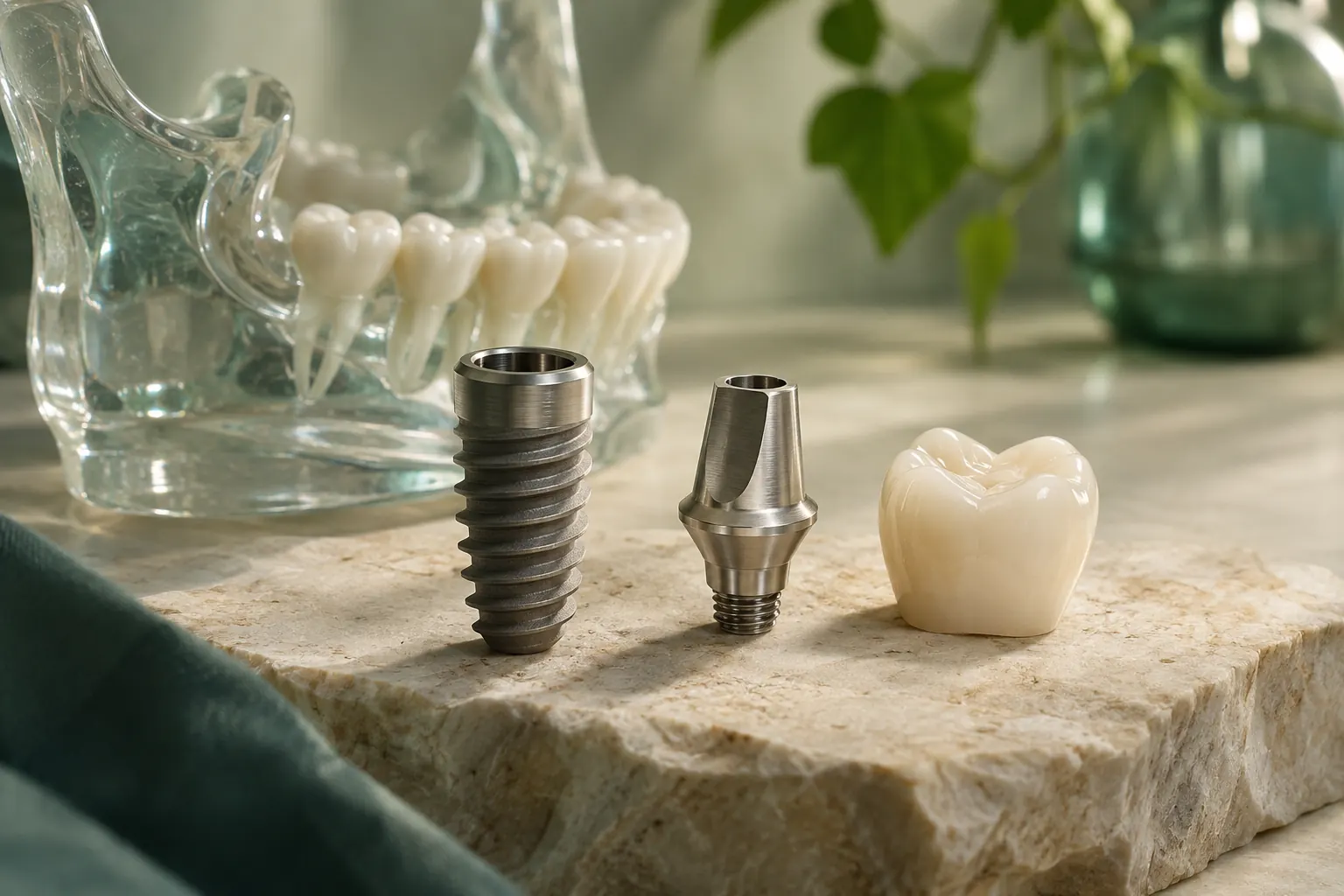
An implant is a titanium post placed in the jaw. Over time, the bone grows close to the " "post. That process is called osseointegration. The dentist usually waits for it before fitting " "the final crown, because the implant needs to be stable under biting force.
One clinic's estimate is 7–14 days for the placement trip, then 3–6 months for the final " "tooth. That is not a universal rule. Healing depends on the site, the bone, your health and " "the dentist's protocol. Ask what the clinic expects for your case.
All-on-4
A full arch on four implants
All-on-4 means a full arch of teeth supported by four implants. Temporary teeth may be possible on the same trip, but that is a clinical decision.
All-on-4 is a treatment for a full arch. Four implants support a bridge of teeth. Some " clinics can fit temporary teeth on the same trip as the surgery. Others use a different " "protocol. The final teeth still need a later stage, after healing.
Do not assume that “All-on-4” means one trip for everyone. A graft, the bone quality, the " "dentist's technique and the lab's schedule can all change the plan. Ask what is temporary " "and what is final.
Ask how the temporary teeth are made, how long you wear them, and what you can eat while " "they are in place. Ask who reviews them after you fly home.
What can add time
The plan can change after the scan
A quote is written before the dentist sees the inside of your mouth. Some changes are predictable, and some are not.
Reasons a trip or a date can move
- A bone graft, because the jaw bone is thin
- An extraction before the implant can be placed
- A sinus lift in the upper jaw
- An infection that needs treatment first
- Healing that is slower than expected
- A lab delay with the crown or bridge
- A remake after a fitting that is not right
- A warranty review that needs you in the clinic
Ask the clinic what would trigger a change and how it would affect the price. A plan that says “we will see when you arrive” is not a plan. A plan that names the likely changes is easier to trust, even when the answer is not what you hoped.
Compare the patterns
Three common shapes of treatment
The table is a guide to the usual pattern, not a promise for your case. All timing is one clinic's estimate.
| Usual pattern (one clinic's estimate) | What happens | What can change | |
|---|---|---|---|
| Single implant | Two trips. 7–14 days for placement, then 3–6 months later for the final tooth. | Consult and scan, place the implant, review, then fit the final crown. | A graft, slow healing or a lab delay can add time. |
| All-on-4 | Often one trip for surgery and temporary teeth, with a later review or final stage. | A full arch on four implants. Temporary teeth may be possible on the same trip. | Bone quality, a graft, the clinic's protocol or a lab delay. |
| Implant with a bone graft | Often a longer first stage or an extra stage. | Graft first, healing, then implant placement and the final tooth. | The graft must settle. The dentist decides when the implant can go in. |
| Crown or bridge | Usually fewer trips, because no implant healing is needed. | Prepare the tooth, scan or impression, then fit the restoration. | Lab time, a fitting that needs a remake, or a change in material. |
Your dentist will confirm the number of trips after an examination. Ask for the plan in writing before you book flights.
Planning around work
Dates, leave and a buffer
The trip plan and the flight plan should be one document. Do not let a cheap fare decide the medical timetable.
Ask the clinic for the dates it controls and the dates that depend on healing. Book the " "first trip around the placement. Do not book the second trip until the dentist confirms " "that the implant is ready for the final tooth.
Leave a free day before the flight home. Tell your employer that the return date may move. If you are travelling with a companion, agree who can stay longer if the dentist asks.
Check your travel insurance for treatment, complications and a delay caused by a medical " "decision. Ask the clinic for the letters your insurer will need.
Questions to ask
Eight questions about trips
Ask these before you pay a deposit. Ask for the answers in writing.
How many trips will I need, and how many days on each?
Ask for a number and a date range. Put the answer beside the treatment plan so you can compare two clinics on the same basis.
Which appointments must be in person?
Surgery and some reviews need you in the clinic. A conversation or a records check may be possible by video. Ask which is which.
When is the final tooth fitted?
A standard implant often waits 3–6 months. That is one clinic's estimate. Ask what it means for your case and whether the final crown is included.
What happens if healing is slower than expected?
Ask how a delay changes the dates, the cost and the warranty. A good answer includes a review and a revised written plan.
Can I have a review by video?
Some reviews can be remote, but not surgery. Ask who examines the site and who signs off the next stage.
Who reviews me at home between trips?
Ask for a named local dentist or a clinic contact. Ask what records they will receive and who pays for that review.
Does the warranty require me to return to India?
Ask before you pay. A warranty that only works if you fly back is a cost you should count in the total.
Can you put the trip plan in writing before I book flights?
Ask for a table with dates, appointments and the condition for flying home. That table is your planning document.
Honest risks
What can go wrong when the trip is too tight
Most problems are not mysterious. They come from a plan that had no room for a second review.
A clinic that rushes work to fit your flight is taking a risk with your treatment. So is " a patient who flies home before the dentist is ready to sign them off. Ask what the clinic " "will do if the work is not finished on time.
A warranty that requires a return trip is a cost, not a comfort. A quote that hides a " "second visit is not cheaper once the flight is added. A plan with no aftercare contact is " "not a plan.
None of this means a short trip is always wrong. It means the trip should follow the " "clinical plan, not the other way round.
Questions, answered
Implant trip questions
Short answers about the number of trips, the wait and the final tooth.
How many trips does a dental implant need?
Can I have an implant in one trip?
How long between the two trips?
Does All-on-4 always mean one trip?
What if I cannot travel for the second trip?
Can I do a review by video?
Last updated
Free plan review
Find out what your trip really needs
Tell us the treatment and where you are travelling from. A coordinator replies within one working day, India time, and explains what to ask about trips and timing.