Free, no-obligation plan review. A coordinator replies within one working day (India time). How it works

All-on-4

All-on-4 in India, the full picture.

A full arch of teeth on four implants: who it may suit, what the trip looks like, the indicative cost and the risks that do not fit on a poster.
  • Indicative $3,000–7,000 per jaw
  • Temporary teeth may be possible
  • Major surgery, explained
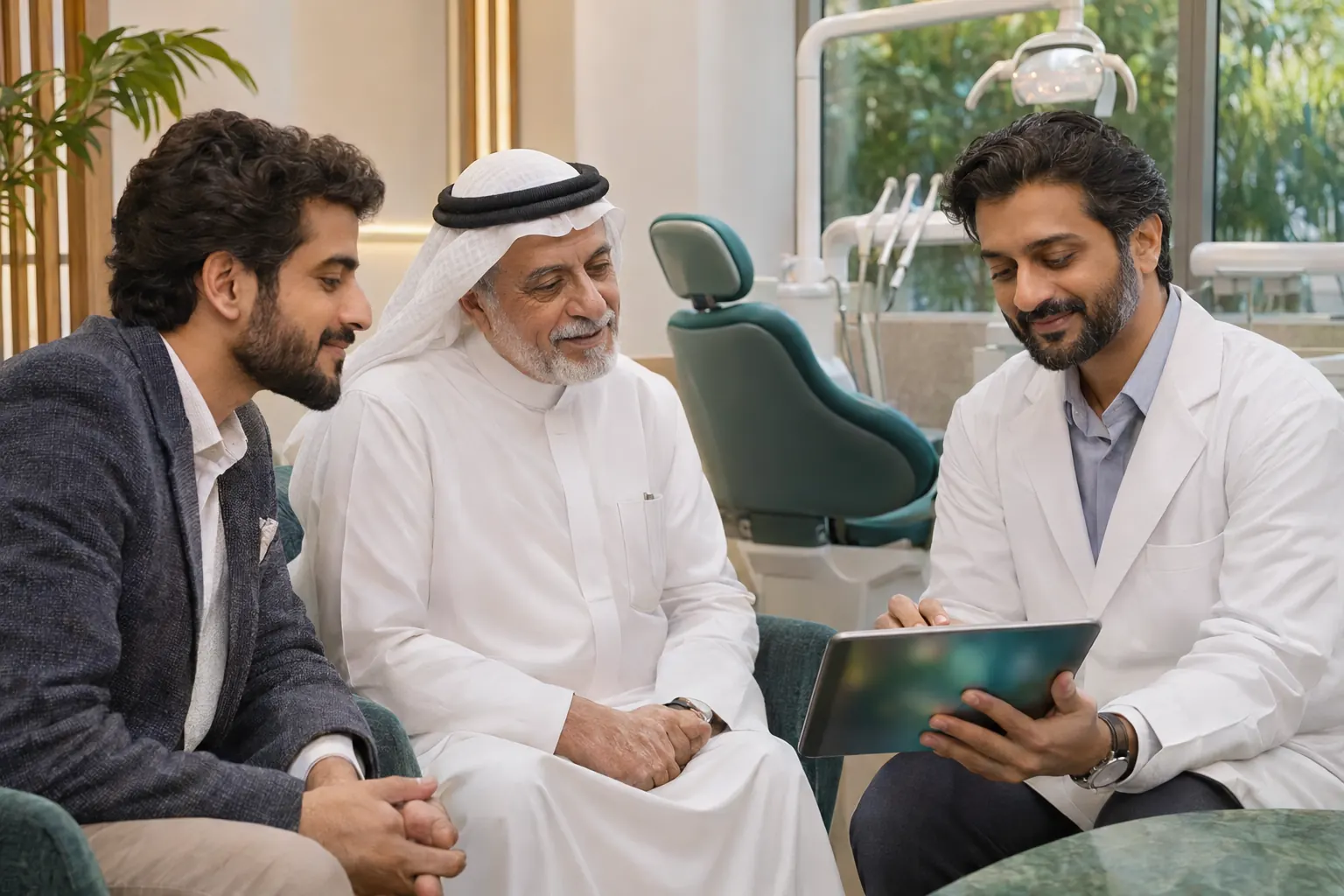
A father and son speaking with a dentist in a consultation room.
Photograph is illustrative.

The short answer

All-on-4 means a full arch of teeth fixed on four implants. It is for people who have lost most or all teeth in one jaw, or whose remaining teeth are loose and need replacing.

Clinics advertise $3,000–7,000 per jaw in India. That is an indicative range from clinic marketing in November 2026, not a quote.

Temporary teeth may be possible on the same trip. The final teeth usually come after healing, on a later trip.

This is major surgery. It changes how you eat, speak and clean, and it has real risks. A denture, a different implant plan or keeping your own teeth may suit you better. Only a dentist who examines you can decide.

Two dentists reading a jaw scan together on a screen.
Photograph is illustrative.

The treatment

What All-on-4 actually means

All-on-4 is a way to replace a full arch of teeth with four implants. The word arch means the whole upper or lower row of teeth. Two implants usually sit toward the front. Two sit further back at an angle, to use the bone you have.

All-on-4 is a treatment concept, not a brand. Clinics use different implant brands and different designs. Ask which one you are getting and who makes the teeth.

The teeth are joined into one prosthesis: a full set of teeth on a frame. It is fixed in place, not taken out like a denture. Some clinics offer a removable overdenture on implants instead. Ask which plan is in your quote.

Temporary teeth may be fitted on the day of surgery or soon after. They are for appearance and soft food. They are not the final teeth, and they can break if you bite hard.

The final prosthesis is made after the implants have settled. It may be acrylic or zirconia. Acrylic is a plastic material; zirconia is a strong ceramic. Each has different wear, repair and cost.

Who it suits

Who All-on-4 may suit, and when it may not

This is a big decision. The lists are a starting point, not a diagnosis, and a second opinion is reasonable.

It may suit you if...

  • You have lost most or all teeth in one jaw.
  • Your remaining teeth are loose or badly broken and cannot be saved.
  • You have enough bone in the front of the jaw, or you are willing to consider a graft.
  • Your general health is stable enough for a longer operation.
  • You can attend the surgery, the reviews and a later trip for the final teeth.
  • You understand that cleaning and diet will change, and that repairs may be needed.
  • You have a plan for aftercare at home.

It may not suit you if...

  • Your own teeth can still be saved. Ask for a second opinion before you agree to remove them.
  • There is not enough bone for four implants, even with a graft.
  • You have a health condition or take a medicine that affects healing or anaesthesia. Only a dentist and your doctor can assess this.
  • You smoke and do not want to stop during healing.
  • You cannot return for reviews or the final fitting.
  • A denture is acceptable to you and you want less surgery.
  • You expect a permanent, maintenance-free set of teeth. All-on-4 needs care and can need repair.

Other options worth asking about

A denture

A removable full denture is simpler, cheaper and avoids surgery. It can be less stable and needs daily care.

Implant overdenture

A denture held by two or more implants. It is removable and often needs less surgery than All-on-4.

Standard implants

More implants and possibly grafting. It may cost more and take longer, but it can suit some mouths better.

Save your teeth

Sometimes gum treatment, root canals or crowns can keep natural teeth. Ask before agreeing to extractions.

Step by step

The usual All-on-4 plan, trip by trip

The plan below is a planning example. Your schedule depends on your health, your bone and the clinic's lab.

  1. 1

    Before you book

    Send recent scans if you have them. Have a video consultation. Ask for the itemised plan, the implant brand, the temporary and final prosthesis, and the warranty.

  2. 2

    Trip 1, day 1–2: examination and planning

    The clinic examines your mouth, takes a CT scan (a 3D X-ray of the jaw) and photos, and confirms the plan. Ask what will be removed and what you will wake up with.

  3. 3

    Trip 1, day 2–4: surgery

    The teeth are removed if needed, the implants are placed and temporary teeth may be fitted. Ask who provides the anaesthetic or sedation (medicine that keeps you comfortable) and who monitors you.

  4. 4

    Trip 1, day 4–10: review and soft diet

    The clinic checks swelling and healing, adjusts the temporary teeth and shows you how to clean. You eat soft food. Do not test the temporary teeth with hard food.

    An older couple being welcomed by a clinic coordinator at a reception desk.
    Photograph is illustrative.
  5. 5

    At home, several months: healing

    The implants settle. Keep the area clean and attend any checks the clinic arranges. Report pain, a loose tooth or a sore spot early.

  6. 6

    Trip 2, plan about a week: final teeth

    The final prosthesis is tried in, adjusted and fitted. The bite is checked and a records pack is prepared for your dentist at home. The clinic confirms how many days this stage needs.

Timings are a planning example

Temporary teeth may be possible on the same trip, but they are not guaranteed. Healing, grafting and lab work can change the days. Ask what happens if you need more time than your flight allows.

Indicative costs, November 2026

What All-on-4 costs in India

The bar compares clinic-marketing ranges for one jaw. It is not a quote, and the final prosthesis is where quotes often differ most.

All-on-4, one jaw

India$3,000–$7,000
USA$35,000–$60,000
UK$20,000–$35,000
Australia$22,000–$45,000
Dubai$12,000–$25,000

Indicative ranges from clinic marketing, November 2026. Not verified, not a quote. Flights, hotels, extra implants, repairs and time off are not included.

What changes the price

  • Four implants or more. A fifth or sixth implant adds cost.
  • The temporary prosthesis and the final prosthesis.
  • Acrylic versus zirconia teeth.
  • Extractions, bone graft or sinus lift.
  • Sedation or a longer anaesthetic.
  • The lab and the dentist's experience.
  • Repairs, remakes and extra visits.

What we do instead of guessing

Aarogic asks for one itemised quote that names the implants, the temporary teeth, the final prosthesis, extractions, sedation, reviews and the warranty. If a clinic will not separate those items, you cannot compare it with another clinic.

The written quote

What the price should include, and what it should not hide

Full-arch quotes vary more than single-implant quotes. Read every line, and ask which items are fixed and which can change.

Ask whether each item is included

  • Consultation, CT scan and photographs
  • Extractions, if they are part of the plan
  • Four implants and abutments
  • Temporary teeth, if planned
  • Final prosthesis and fittings
  • Surgery, anaesthetic or sedation
  • Review visits before you fly home
  • Medicines and aftercare instructions
  • Implant passport and warranty terms
  • A records pack for your dentist at home

Usually outside the quote

  • Flights, hotels, visas and transfers
  • Travel and health insurance
  • A fifth or sixth implant, or a graft, if needed
  • Repairs to temporary teeth
  • Replacement of the final prosthesis
  • Treatment of complications after you fly home
  • Check-ups with your dentist at home
  • Time off work, meals and extra nights
  • A spare set of teeth
A rule that saves arguments

If an item is not written down, treat it as not included. Ask the clinic to list every item and every possible extra charge in the plan.

Honest risks

What can go wrong, and what to plan for

All-on-4 is not a small procedure. The risks below are the ones to discuss before you agree to surgery, not after.

One or more implants may fail

An implant can fail to fuse with the bone. The plan may need another implant, a graft or a denture. That means more surgery, more time and more cost.

The temporary teeth can break

Temporary teeth are a bridge to the final teeth, not the final teeth. Avoid hard food. Ask whether repairs are included.

The final teeth can chip or loosen

A prosthesis can chip, loosen or break. Repairs and replacements are part of life with it. Ask what they cost and what the warranty covers.

Speech and eating change

The tongue and lips need time to adapt. Some sounds and foods are harder at first. Ask for a realistic recovery picture, not a promise.

Hygiene is harder than with natural teeth

Food can trap under the prosthesis. You need special brushes and regular checks. Poor cleaning can lead to gum inflammation and bone loss.

Nerve, sinus and anaesthetic risks

Surgery near nerves and sinuses carries risk, and sedation has its own risks. Ask who provides it and what monitoring is used.

Before you agree

Questions to ask the dentist

These questions are longer than a single-implant list because the plan is bigger. Ask them before you pay a deposit.

Take this list to the consultation

  • Can my own teeth be saved, or is removal really necessary?
  • Is All-on-4 the right plan, or would a denture, an overdenture or standard implants suit me better?
  • How many implants, which brand, and what happens if one fails?
  • Will I leave with temporary teeth? What can I eat with them?
  • Is the final prosthesis acrylic or zirconia? Who makes it?
  • Are extractions, grafting or sinus lifts included?
  • Who provides sedation or anaesthetic, and who monitors me?
  • How many trips and days? What if healing is slower?
  • What does the warranty cover on the implants and on the teeth, separately?
  • What repairs are likely, and what do they cost?
  • Who handles aftercare at home? Will you share records?
  • What is your State Dental Council registration, and who is on the surgical team?
  • What will I owe if I stop after the temporary teeth?
If a question cannot be answered

If the clinic cannot name the surgeon, the anaesthetist and the legal entity behind the warranty, do not book. Those are basic facts, not trade secrets.

A clinic team of doctors in a meeting room.
Photograph is illustrative.

Checking the dentist

Check the dentist, not just the clinic

All-on-4 is a bigger operation than a single implant. Ask who is in the room, not only who owns the clinic.

  • The dentist who will do the surgery, by name.
  • Their State Dental Council registration, council and year.
  • Who provides the anaesthetic or sedation, and their qualification.
  • The implant brand and how many full-arch cases the team handles.
  • The legal entity that backs the warranty.
  • The person who answers aftercare questions from abroad.

Ask to see the sterilisation area and the records pack they will give you. Each Indian state has its own dental council, and the Dental Council of India keeps the Indian Dentist Register at dciindia.gov.in. Registration shows a licence, not skill. Before listing a clinic, we check the treating dentist's registration and ask for itemised quotes, warranty terms and a written aftercare plan.

Questions, answered

All-on-4: questions people ask

These are the questions that change the decision most often. Ask them again in your own consultation.

What is All-on-4?
All-on-4 means a full arch of teeth fixed on four implants. Two implants usually sit toward the front and two further back at an angle. The teeth are joined into one prosthesis. It is a treatment concept, not a single brand.
How much does All-on-4 cost in India?
Clinics advertise $3,000–7,000 per jaw (indicative, November 2026). That is a marketing range, not a quote. The final prosthesis, extra implants, extractions, sedation and repairs can change the total. Ask for an itemised quote.
Will I leave with teeth?
Temporary teeth may be possible on the same trip. They are not guaranteed, and they are not the final teeth. Ask what you will leave with, what you can eat, and what happens if the temporary set breaks.
How many trips will I need?
Often two: the first for surgery and temporary teeth, the second after healing. Healing can take several months. Some plans differ, so ask for your own written schedule.
Is All-on-4 permanent?
No. The implants can last for years, but the prosthesis wears and can chip, loosen or need replacing. Ask what the warranty covers, what voids it, and what repairs cost.
Can I eat normally afterwards?
You can return to a normal diet as healing allows, but very hard foods can damage the teeth or the prosthesis. With temporary teeth, stay on soft food. Ask the clinic for a written diet plan.
What happens if one implant fails?
The plan may need another implant, a graft or a different prosthesis. That can mean more surgery, more time in India and more cost. Ask how the clinic handles a failed implant and who pays for what.
All-on-4 or a denture?
A denture is simpler, cheaper and avoids surgery, but it can be less stable and needs daily care. All-on-4 is fixed and needs surgery, healing and maintenance. Neither is risk-free. Ask for both options in writing, with the total cost over several years.

Free plan review

Get a full-arch plan in writing

Tell us what you have been told and where you are based. A coordinator replies within one working day, India time, and explains what a full-arch quote should contain. No obligation.

An older couple being welcomed by a clinic coordinator at a reception desk.
Photograph is illustrative.
WhatsAppFree plan